
Broadcom Sees AI Revenue Reaching $230 Billion. So Why Did the Stock Fall?
Broadcom just delivered one of the strongest earnings reports the semiconductor sector has seen in years: record results, higher guidance, and a two-year AI roadmap with extraordinary numbers. Yet the stock is down roughly a quarter from its June high. Here is what happened, and why the market is not cheering.
By AlgovestIQ Research Team
Earnings data Sep 2, 2026; factor data as of Sep 10, 2026
Written with AI assistance, reviewed by a human editor, and verified against Broadcom's Q3 FY2026 results and earnings-call commentary. Not investment advice.
There is a particular kind of earnings report that, by conventional logic, should send a stock sharply higher.
Broadcom delivered one on September 2. Yet the shares have continued to drift lower.
By this week, AVGO was trading around $361, about 27% below its $495 high in early June. The stock was also below both its 50-day and 200-day moving averages and showing a strong sell technical consensus, even as Wall Street analysts kept their price targets clustered in the $500s.
That gap between an exceptional quarter and a market that keeps selling the stock is the central story.
The quarter was exceptional
Start with the numbers. Unless otherwise noted, the figures below are on a non-GAAP basis, which is how Broadcom and Wall Street typically frame the company's operating performance.
Revenue reached a record $29.6 billion, up 86% year over year. Operating income hit a record $20.1 billion, up 92%, while operating margin expanded to a record 67.9%.
Non-GAAP earnings came in at $3.32 per share, up 96% and comfortably ahead of the roughly $3.22 consensus estimate.
Free cash flow reached a record $13.7 billion, meaning Broadcom converted about 46 cents of every revenue dollar into free cash flow.
For investors reconciling those figures with the GAAP results, reported net income was $13.1 billion and GAAP EPS was $2.75. The widely cited $3.32 figure is non-GAAP.
The main engine, unsurprisingly, was AI.
AI semiconductor revenue more than tripled to $16.7 billion, up 221% year over year, and now accounts for 56% of Broadcom's total business, up from 49% just one quarter earlier.
Custom accelerators, the XPUs Broadcom co-designs with major AI companies, saw shipments rise more than 3.5 times and accounted for 73% of AI revenue. AI networking, including the switches and optical equipment that connect those chips, grew more than 2.5 times.
The rest of Broadcom continued to provide a substantial earnings base. Infrastructure software, driven by VMware, generated $8.8 billion of revenue at a 94% gross margin. Non-AI semiconductor revenue was roughly flat at $4.2 billion.
Those businesses may attract less attention, but they provide an important foundation beneath the AI growth story.
The forecast was even bigger
If the quarter was strong, the guidance was stronger.
For the current quarter, Broadcom expects revenue of about $34.8 billion, up 93%, with AI revenue alone reaching $21.7 billion.
That would bring fiscal 2026 AI revenue to roughly $58 billion, above the $56 billion outlook the company provided one quarter ago.
Then CEO Hock Tan went further.
Broadcom expects AI revenue to double to about $115 billion in fiscal 2027, then double again to roughly $230 billion in fiscal 2028.
Taken together, the company is telling investors it has secured the supply needed to support roughly $350 billion of AI semiconductor revenue across those two years.
Tan also offered a figure Broadcom rarely provides: potential earnings power of more than $30 per share by fiscal 2028.
He is well aware of how aggressive those numbers sound. When an analyst asked whether demand could ultimately run even higher, Tan joked, "Whatever I tell you, you guys go on and print a bigger number." The comment was humorous, but it also captured the challenge facing investors. Expectations are already enormous.
Who is buying all of this?
The bull case increasingly rests on a relatively small group of customers, and Broadcom provided unusually detailed commentary on several of their roadmaps.
Google has signed a long-term agreement covering future generations of its TPU accelerators. Broadcom expects annual TPU shipments to eventually reach multi-tens of billions of dollars. Google's Ironwood chip is shipping in volume, while the next generation TPU v8i is already in production.
Anthropic plans to deploy one gigawatt of compute in 2026, followed by another five gigawatts in 2027 and 10 gigawatts in 2028. Broadcom expects Anthropic to become its largest custom chip customer next year.
OpenAI has received its first Broadcom-built accelerator, codenamed Jalapeno. The roadmap calls for 1.3 gigawatts of deployment in 2027 and more than five gigawatts in 2028, which could make OpenAI Broadcom's second largest XPU customer. A third generation chip is already in development.
Meta continues to expand its MTIA accelerator program, with three chip generations expected through 2027.
Broadcom is also extending its position in AI networking. The company recently taped out Tomahawk 7, which it describes as the industry's first 200 terabit Ethernet switch, while continuing to push Ethernet into the scale-up market traditionally served by proprietary interconnect technologies.
The pipeline is extraordinary.
It is also one source of investor concern, because much of the $230 billion AI revenue vision depends on a handful of customers executing large and highly complex infrastructure plans on schedule.
So why is the stock falling?
This is where an excellent earnings report and an attractive entry point can diverge.
Several factors are weighing on the stock despite the strength of the underlying results.
Margins are becoming more complicated. Gross margin fell to 75% during the quarter and is expected to decline to roughly 73% next quarter, compared with 78% a year ago. The reason is the rapid growth of XPUs, which contain significant amounts of expensive memory and carry lower gross margins than some of Broadcom's other businesses.
Management has encouraged investors to focus more closely on operating margin, which remains near 66%. That is a reasonable argument. But for a stock trading at a premium valuation, a declining gross margin can still make investors more cautious, even if operating leverage remains strong.
Broadcom is helping finance the infrastructure behind its demand. Through a new platform involving Apollo and Blackstone, Broadcom is helping support more than 20 gigawatts of compute infrastructure for OpenAI and Anthropic. The first $35 billion tranche closed in June.
Broadcom says third parties are underwriting the assets and that its own exposure is limited to modest residual value guarantees. Even so, the structure creates an important question for investors. When a semiconductor supplier is involved in financing the infrastructure that ultimately supports demand for its chips, the quality and independence of that demand deserve closer scrutiny.
Revenue per gigawatt is lower than some investors expected. When Bernstein analyst Stacy Rasgon pressed management on the economics, Broadcom indicated that its revenue opportunity is roughly $20 billion to $30 billion per gigawatt of deployed compute. That is below the roughly $40 billion figure some competitors had previously suggested.
Deployment plans are not the same as completed shipments. Even Tan acknowledged that having visibility into roughly 30 gigawatts of planned capacity across 2027 and 2028 does not guarantee that all of it will be deployed on schedule.
Land, power availability and data center construction all have long lead times. Advanced substrates and high-bandwidth memory also remain potential bottlenecks. Broadcom says the $115 billion and $230 billion AI revenue forecasts already incorporate management's judgment about these constraints.
The valuation still assumes exceptional execution. Even after the recent pullback, AVGO continues to trade at a premium valuation for a company whose growth is extraordinary but increasingly concentrated among a small number of major AI customers. When a stock is priced for exceptional execution, strong results alone may not be enough.
The AIQ read: a great company, but a complicated setup
That tension is precisely what the AlgovestIQ AIQ Score is designed to capture.
AVGO currently carries a neutral AIQ Score of 52 out of 100.
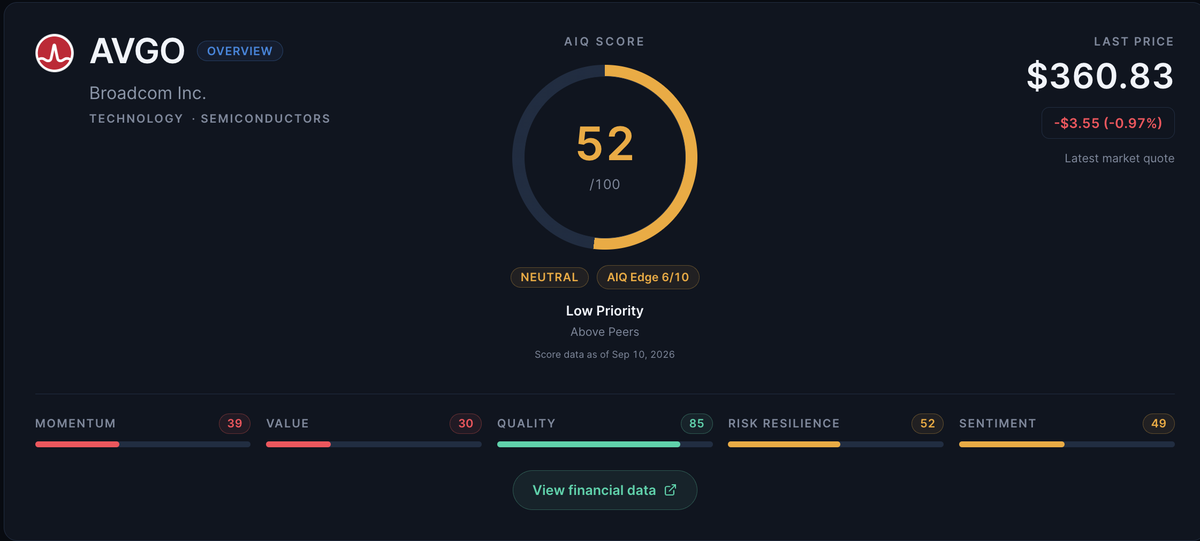
The factor breakdown is more informative than the headline score.
Quality scores 85, reflecting Broadcom's exceptional margins, cash generation and returns.
But Value stands at 30 and Momentum at 39. The technical picture is also weak, with the stock trading below its key moving averages and the near-term trend continuing to deteriorate.
The result is a familiar investment profile: an exceptional business trading at a demanding valuation while its share price loses momentum.
None of this is a prediction about where Broadcom's stock goes next.
Wall Street remains broadly bullish, with a consensus buy rating and an average price target near $505. That implies substantial upside if Broadcom's AI ramp develops anywhere close to management's guidance.
The company has also now beaten estimates for eight consecutive quarters.
The narrower point is that a strong quarter and an extraordinary long-term forecast do not automatically make the stock attractive at every price.
The business and the stock can operate on different timelines.
What to watch next
Broadcom is scheduled to report fiscal Q4 results after the close on December 9.
Three areas may matter more than the headline earnings beat.
1. Margin trajectory. Does the growing XPU mix continue to pressure gross margin, and can operating leverage keep operating margin near 66%?
2. The fiscal 2027 ramp. Management has said it does not plan to update the $115 billion and $230 billion AI revenue figures every quarter, so customer commentary and deployment timelines may matter more than any new headline forecast.
3. The financing structure. Investors should watch how much of the OpenAI and Anthropic infrastructure buildout runs through the Apollo and Blackstone platform, and whether Broadcom's own financial exposure remains as limited as management has indicated.
Broadcom spent this quarter demonstrating that it is no longer simply a beneficiary of the AI infrastructure boom. It has become one of the companies helping define that infrastructure.
The market appears to believe the growth story.
What investors are still deciding is what that growth is worth, how much execution risk should be priced in, and whether the current share price offers enough margin for error.
This article is for informational purposes only and is not investment advice. Figures are drawn from Broadcom's Q3 FY2026 results and earnings call for the fiscal period ended August 2, 2026. AIQ Score and factor readings reflect the latest market close snapshot and are descriptive research, not forecasts. Investing involves risk, including possible loss of principal.
References
- Q3 FY2026 results: revenue $29.6B, non-GAAP EPS $3.32, operating income $20.1B, operating margin 67.9%, free cash flow $13.7B. Source: Broadcom Q3 FY2026 results and earnings-call commentary, Sep 2, 2026.
- AI semiconductor revenue $16.7B, fiscal 2026 AI revenue outlook roughly $58B, fiscal 2027 and fiscal 2028 AI revenue roadmap of about $115B and $230B. Source: Broadcom Q3 FY2026 earnings call, Sep 2, 2026.
- AIQ score and factors: overall 52/100, Momentum 39, Value 30, Quality 85, Risk Resilience 52, Sentiment 49. Source: AlgovestIQ AIQ score data, as of Sep 10, 2026.
- Analyst consensus, price target context, moving-average positioning and eight-quarter earnings beat streak. Source: AlgovestIQ research panels, as of Sep 10, 2026.